Skip to content
Mohammad Mohaghar Research Engineer II

Mohammad Mohaghar

Research

My research uses advanced experimental diagnostics to investigate complex fluid flows spanning hydrodynamic instabilities, environmental transport, biological propulsion, and bio-inspired soft robotic systems.

Current projects

Double-diffusive instability

This research investigates double-diffusive instability (DDI), a class of buoyancy-driven flows that arises when fluid density depends on two scalar quantities—such as temperature and salinity—that diffuse at different rates. This competition between stabilizing and destabilizing density gradients can generate a variety of convective structures and mixing regimes even when the overall density stratification is statically stable. DDI plays an important role in geophysical and environmental systems, particularly in oceans and lakes, where it can influence vertical transport of heat and dissolved constituents, mixing across stratified interfaces, and the development of layered structures such as thermohaline staircases. Our broader objective is to understand how these instabilities develop, transport scalar quantities, interact with their surroundings, and transition between different flow and mixing regimes.

A current focus is finger-type DDI, studied experimentally in a controlled configuration with warm, salty water overlying cold, fresh water. Because heat diffuses substantially faster than salt, small disturbances develop into vertically elongated fingers that transport fluid and scalar quantities across the stratification. High-resolution simultaneous PIV and PLIF measurements provide co-located velocity and concentration fields, while automated tracking enables the growth and evolution of large populations of individual fingers to be quantified. These experiments are complemented by three-dimensional direct numerical simulations that provide access to temperature, salinity, velocity, and buoyancy fields beyond the planar measurements. Current work examines finger growth and saturation, vortical structure, scalar transport and mixing, lateral interactions and secondary instabilities, including the transition from predominantly vertical mushroom-shaped fingers to asymmetric zig-zag and lateral-drift behavior under stronger forcing. Together, these studies form a foundation for a broader investigation of double-diffusive convection and its role in mixing and transport in stratified environments.

Flow dynamics of bio-inspired soft robotic swimmers
This research investigates the fluid dynamics of bio-inspired soft robotic swimmers, with particular emphasis on how compliant-body motion, morphology, and actuation determine propulsion and the structure of the surrounding flow. Our work combines magnetically responsive soft materials with high-speed imaging and three-dimensional tomographic particle image velocimetry (tomo-PIV) to connect swimmer kinematics with the velocity, vorticity, strain, dissipation, and coherent structures generated in the wake. Building on our previous work showing how asymmetric geometry and actuation can substantially alter three-dimensional vortex formation and swimming kinematics, current studies examine multi-legged, jellyfish-like soft swimmers with systematically varied morphology. A central question is how appendage number and spacing reorganize the wake—from distinct structures generated by individual appendages toward more collective, bell-like propulsion—and how these changes influence thrust generation, swimming performance, stability, maneuverability, and energetic efficiency.

The project also serves as an integrated research and education platform through the Vertically Integrated Projects (VIP) course Flow Dynamics of Soft Robotic Swimmers, which I instruct at Georgia Tech. Multi-semester teams of undergraduate students contribute directly to the development of new soft robotic platforms through conceptual design, CAD and fabrication, magnetic and other actuation systems, electronics, experimental testing, and flow visualization. The students work alongside graduate researchers to iteratively improve the robots based on their measured kinematics and hydrodynamic performance. This combination of fundamental flow measurements and hands-on robotic development provides a pathway for translating insights from biological propulsion into controllable soft robotic systems while simultaneously training students at the intersection of fluid mechanics, robotics, and bio-inspired engineering.

Previous projects

Turbulent mixing in a shock-driven variable-density flow (Richtmyer-Meshkov instability)
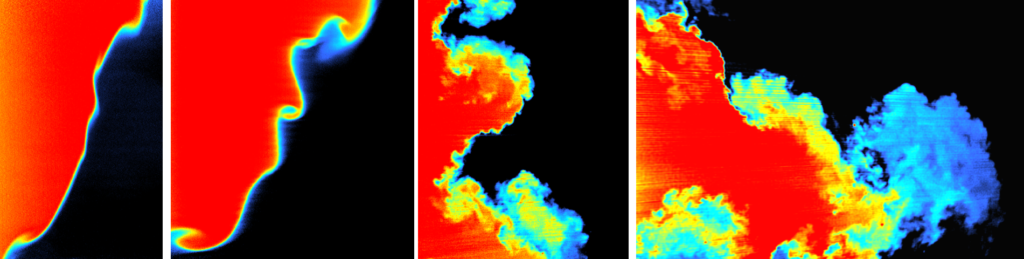
This research investigates the evolution and transition to turbulence of shock-driven variable-density flows governed by the Richtmyer–Meshkov instability (RMI). When a shock wave interacts with a perturbed interface separating fluids of different densities, baroclinic vorticity is deposited at the interface, initiating deformation, vortex formation, and ultimately complex turbulent mixing. Using shock-tube experiments with simultaneous particle image velocimetry (PIV) and planar laser-induced fluorescence (PLIF), this work examined how the evolution of the mixing layer depends on key physical parameters, including the initial interface perturbations, shock Mach number, density contrast (Atwood number), and circulation deposited during shock and reshock interactions.

The experiments were complemented by temporally resolved measurements and high-resolution three-dimensional simulations to examine the development of vorticity, coherent structures, turbulent scales, and mixing before and after reshock. A central focus of this work was understanding how strongly the flow retains a memory of its initial conditions as large-scale structures break down into progressively smaller scales and the system approaches a more turbulent state. The combined experimental and computational studies provide a detailed picture of the mechanisms governing the transition from shock-induced interface deformation to three-dimensional turbulent mixing.

Scalar mixing in turbulent boundary layers

This research examines the mixing and multiscale structure of high-Schmidt-number passive scalars released into turbulent boundary layers. Using planar laser-induced fluorescence (PLIF), the experiments resolved thousands of instantaneous concentration fields and quantified how scalar structures evolve with downstream distance, Reynolds number, and the initial size of the scalar release. The analysis focused on scalar power spectra, integral and Taylor length scales, fractal characteristics of scalar interfaces, and the approach toward self-similar and locally isotropic behavior as turbulent mixing develops.

A key objective was to determine how classical turbulence scaling concepts apply to strongly intermittent scalar fields at high Schmidt number. The measurements showed distinct spectral behavior across different scale ranges and revealed significant departures from Batchelor’s classical viscous-convective scaling, with small-scale intermittency providing an important explanation for these differences. The work provides experimental insight into how passive contaminants and other high-Schmidt-number scalars are stretched, folded, and mixed within turbulent environmental flows.

Non-linear internal waves

This research investigates the dynamics of weakly non-linear standing internal waves in stratified fluids using phase-matched particle image velocimetry (PIV) and planar laser-induced fluorescence (PLIF) measurements. Laboratory experiments in a two-layer density-stratified system were used to quantify the evolution of the interface, wave amplitude and period, interface thickness, velocity field, shear strain rate, and vorticity throughout the wave cycle. Velocity and density measurements were acquired separately with a single camera and combined by matching their phases within the repeatable standing-wave cycle. Comparison with linear and higher-order theoretical predictions revealed clear non-linear effects, including steeper wave profiles and sharper interfaces near the antinodes, together with enhanced shear and vorticity along the density interface. These measurements provide insight into how non-linearity modifies the structure and dynamics of internal waves and the associated transport and mixing processes in stratified environmental flows.

Flow fields around free-swimming zooplankton

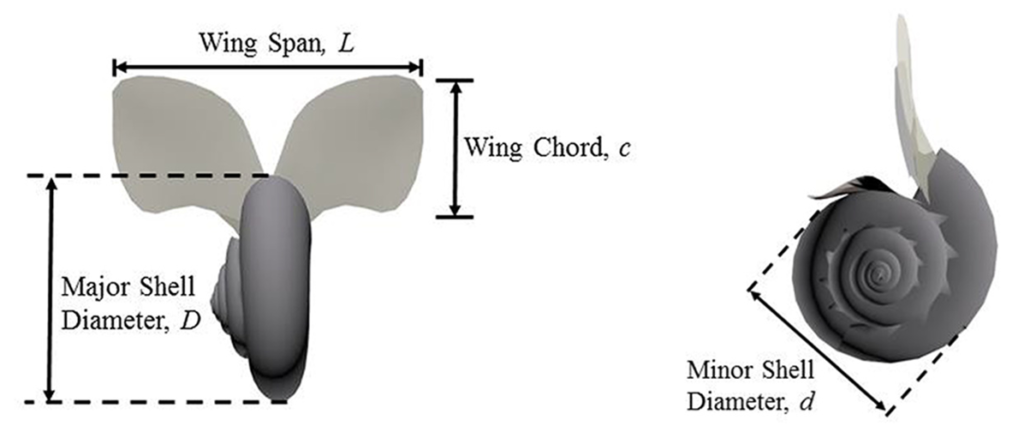
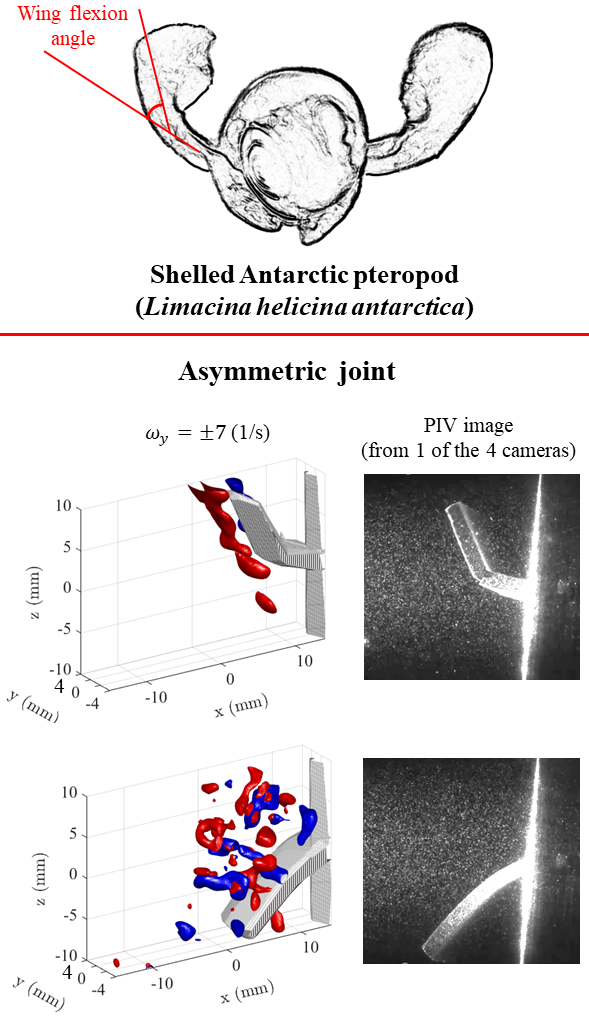
This research examines the fluid mechanics and swimming behavior of freely moving zooplankton, with the broader goal of understanding how small aquatic organisms interact with and manipulate the surrounding flow for propulsion, maneuvering, feeding, and environmental sensing. Using high-speed imaging, particle image velocimetry (PIV), and three-dimensional tomographic PIV (tomo-PIV), the work has investigated several ecologically important organisms—including copepods, Antarctic krill, and shelled Antarctic pteropods—across a range of swimming modes and hydrodynamic conditions. The measurements connect organism kinematics with the velocity, vorticity, strain-rate, and wake structures generated in the surrounding fluid, providing insight into how morphology and appendage motion determine locomotion at intermediate Reynolds numbers.

The research also addresses the two-way interaction between zooplankton behavior and their fluid environment. Laboratory experiments with copepods in stratified flows showed that their trajectories near internal waves cannot be explained by passive advection alone, indicating an active behavioral response to hydrodynamic and density cues. Studies of pteropods revealed an unusual flapping propulsion mechanism with similarities to insect flight, while volumetric measurements around adult Euchaeta antarctica showed that rapid turning produces stronger velocity, vorticity, dissipation, and hydrodynamic cues than steady cruise swimming. More recently, tomo-PIV measurements of Antarctic krill quantified the three-dimensional wakes generated by different metachronal swimming modes and revealed vortical structures near the pleopod tips that support a lift contribution in addition to drag-based propulsion. Together, these studies provide a mechanistic view of how zooplankton locomotion, sensing, and behavior are coupled to the surrounding fluid.